High Altar
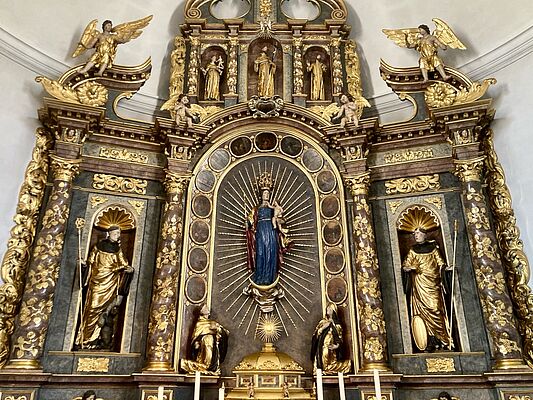
The high altar was consecrated in 1687. It was restored from 1937 to 1939 and again in 1987. It is believed to have been created in the workshop of Ritz von Selkingen in Valais—or by an altar maker closely associated with Ritz.
At the center of the high altar, the Virgin Mary floats on a cloud, surrounded by a halo. She is enclosed within a semicircular frame consisting of oval paintings depicting the 15 mysteries of the Rosary. Below her, kneeling, are Saint Dominic (left) and Saint Catherine of Siena (right). Saints Gallus (left) and Otmar (right) flank the Virgin Mary.
The dove on the high altar, directly above Saint Francis, symbolizes the Holy Spirit.
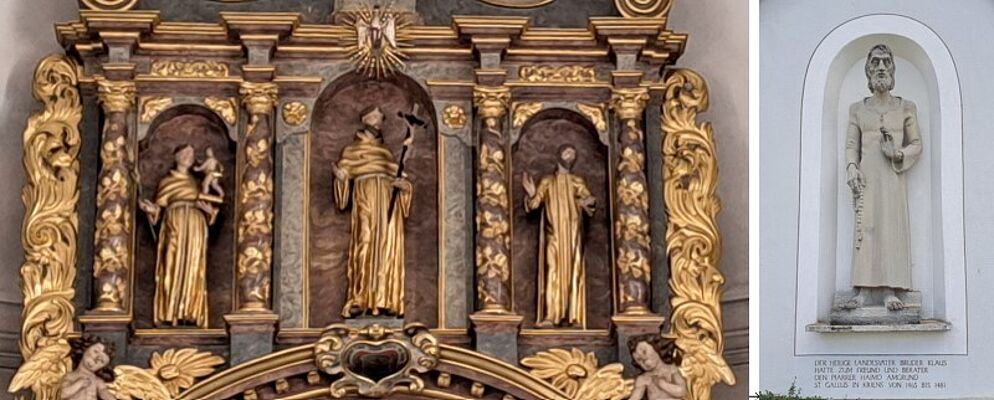
In the upper right corner of the high altar stands the figure of Niklaus von Flüe, Brother Klaus (1417–1487). This is remarkable. For in 1687, when the high altar was created, he had not yet been canonized—that did not happen until 1947. Nevertheless, he was immortalized there, alongside Anthony of Padua and Francis of Assisi.
This is likely due to the fact that Pastor Heimo Amgrund (pastor at St. Gallus Church in Kriens from 1465 to 1481 and then in Stans from 1481 to 1493) was a close friend and advisor to Brother Klaus.
Pastor Amgrund played a key role in the Stans Agreement of 1481, an important peace treaty among the Swiss Confederates. He traveled from Stans to the Ranft region to seek Brother Klaus’s counsel. He conveyed this counsel to the Diet, thereby contributing significantly to the agreement.
The statue of Brother Klaus on the east facade of St. Gallus Church serves as a reminder that Brother Klaus was deeply revered by the local population. The statue was installed only in recent times.
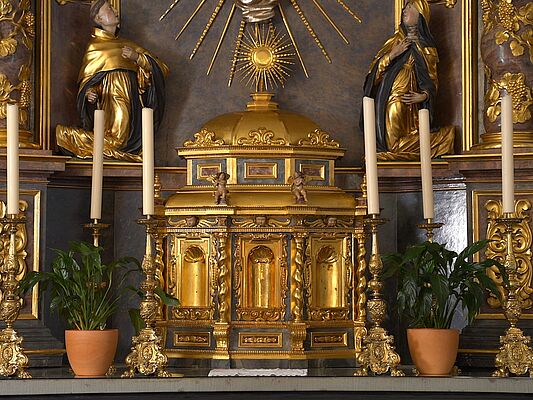
The tabernacle dates from 1685. It was consecrated in 1687. Thieves have stolen valuable objects from the high altar on several occasions. That is why the figures are missing from the tabernacle.
On the antipendium, the base of the altar, one can see the coats of arms of the influential Lucerne patrician families Meyer von Schauensee and Fleckstein.
The Meyer von Schauensee family had owned Schauensee Castle since 1749 and was among the most influential patrician families in Lucerne. Members of the family held high secular and ecclesiastical offices. For centuries, there was a very close connection between Schauensee Castle and St. Gallus Church.
The Fleckenstein family were not landlords in Kriens. They were leading council families. Several family members served as mayors, bailiffs, and significant financial backers of ecclesiastical and public buildings.
This suggests that the tabernacle was donated by these families.