Side Altars
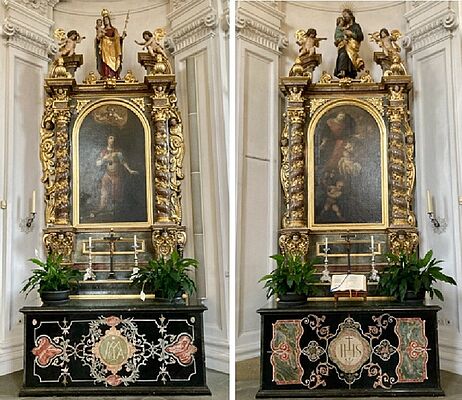
Directly to the left and right of the choir arch stand the two inner side altars. They were crafted in a different workshop than the high altar. This is evident from their stiffer structure and, above all, the abundant use of the “cartilage style”—those Baroque ornamentations featuring cartilaginous thickenings. The altars originally stood in the Spitalkirche in Lucerne at Barfüesserplatz 1, which was demolished in 1788.
On the left, you can see the St. Barbara Altar. Its pediment features a statue of the Virgin Mary with the Infant Jesus, flanked by two cherubs.
On the right, the altarpiece depicts a different scene: St. Anthony and Mary with Jesus. Above it, on the pediment, St. Joseph stands watch. He, too, is flanked by two cherubs.
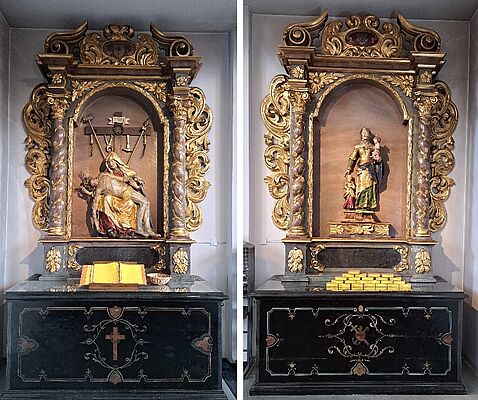
The niche altar featuring the Pietà (the Virgin Mary in mourning, holding the dead Jesus Christ in her lap) dates from the last third of the 17th century. The year 1591 is inscribed on its structure. This date refers only to the altarpiece, not to the construction of the altar as a whole.
Stylistically, we date the wood-carved Pietà itself to the late 16th or early 17th century. The niche altar with the Pietà likely served earlier as an altar in the mortuary chapel.
What we know for certain is that the Pietà—as well as the figurative work on the high altar—originates from the workshop of the Tüfel family of sculptors from Sursee.
The structure of the St. Anne Altar on the right was added later. However, the wood-carved “Anna selbdritt” figure dates from the same period as the Pietà (16th/17th century).
“Anna selbdritt” refers to a depiction of St. Anne with her daughter Mary and the infant Jesus.